To Pray That This Place Succeeds

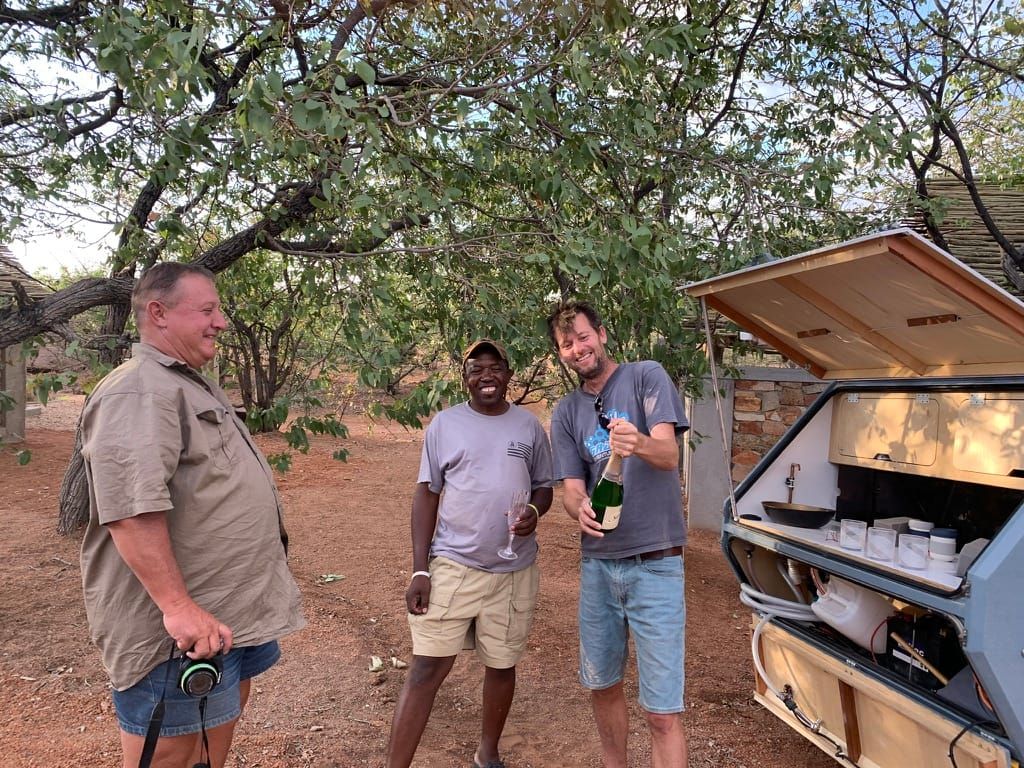
Asser has been involved with the Hobatere Roadside Conservancy for over twenty years. His connection to the land, its wildlife and its people exists outside of time. This is a portrait of a conversation — and of the discomfort of not quite knowing how to sit inside it.
A longer read, but hopefully worth the time.
"But Asser, he was your enemy."
'Jaaa,' he responds, giving into one of his pauses. He shrugs his shoulders and reaches out to close the door. 'But that was then.'
Asser supports Manchester United. He lists all the major players since the early 1990s to me and for a moment I am grateful for the brief period in my life when I was obsessed with Ryan Giggs. I may have been all of 9 years old, but it seems that over-sized t-shirt I used to wear with a giant photograph of Giggs on the front eventually came to some good use, if only twenty-five years later. I am hesitant to go as far as to write that it 'equalised' the space or 'democratised' the conversation: the parlance of social justice often serves to render complicated the most ordinary of human interactions. My childhood crush on Ryan Giggs gave us something to laugh about in the stifling heat of the small office room, where I interrupted Asser catching up on Premier League news on Youtube and sipping on an ice cold Sparberry.
Asser has been involved with the Hobatere Roadside Conservancy for over twenty years, but his connection to the land, its wildlife and its (his) people, exists outside of time. You can sense it through the cadences in his voice, his emphatic pauses and his use of possessive pronouns: …my community, our livestock, my ancestors. He invites his daughter, Vip, to join us. She is wearing a bright blue t-shirt which reads Sarcastic? Me? Never! It seems out of place against the brown and beige background of the bush. Asser is seated on a camping chair, Vip stands next to him, and I sit on a small cooler box, looking up at the two of them. It strikes me that none of us is speaking eye to eye.
We are in 'Herero country', he explains, 'all this land' — he gestures towards the Galton Gate of Etosha — 'all this used to be ours.' He is, no doubt, referring to the establishment of Etosha by the German colonial authorities in 1908, which resulted in the forced removal of the Herero from their territory. They settled, subsequently, alongside the fence of Etosha (the area of which is greater than that of England), hoping, one day, to return. As was the case with the Ovambu and the Himba tribes in Kaokaland, the grazing land and livestock of the Herero was all but destroyed during the fierce clashes fought in and around the Kunene region, both during the Border War and during the fight — or, as Asser refers to it, 'our fight' — for independence. A few meters away, I can hear Jassie asking Martlie to bring more 'orange juice' to the table.
The seat of the Herero people is in Otjokavere, not too far north of where we are staying. The current Headman of the Herero in Kaokaland is Ben K. Mazuma, a direct descendent of Kefas Mazuma, the Namibian nationalist who seems to be a mythical protagonist in the story of liberation. Like the Via Garibaldi or Via Cavour in cities and towns of Italy, Otjokavere's main road, Kefas Mazuma, celebrates its heroic Headman. According to Herero history, the Mazumas have a long tradition of resisting foreign interference, Asser explains, which dates as far back as the Dutch occupation of southern Africa, and continued well into the 1980s. Asser is proud of the role that conservation of nature and wildlife has played, and continues to play, in Herero culture. Before hunting rights were seconded to Trophy Hunting companies as part of the establishment of the conservancies, there were strict rules which governed their self-sustaining lifestyle. Hunting was only permitted in the winter months, and it was forbidden to kill female animals. Asser's adolescent daughter, Vip — a silent observer until now — adds that this meant that the meat would last longer and pregnant females would survive. In the summer months, they are meant to look after their cattle and drink sour milk. I notice how she glides between the past and the present tense.
Staunch supporters of SWAPO, the relationship between the incumbent government and the Herero traditional authorities is strong. Homecoming to Etosha seems unlikely, but negotiations between the politicians and the traditional authorities since the establishment of the conservancy in 1996 have reaped significant rewards for the communities settled along the fence lines. The community has traversing rights, which allows them to enter the park freely and, with enough capital, they can compete with private companies offering lucrative game drives. The conservancy owns the land around the national reserve and is granted hunting rights by the government, which they then lease out to lodges or, in some cases, private individuals. 'What do you think of trophy hunting companies?' I ask Asser, knowing, of course, that it is because of hunting that Jassie initially became involved in the Hobatere project. 'It's good,' he responds. 'They are professionals; they don't make mistakes like we do. It's conservation hunting. We can control it better, and they have to give the meat back to our community.' It will not be the last time that I realise that the threads which hold my 'principled assumptions' are starting to disintegrate.
With the operational and financial assistance of an American benefactor, who has leased the land and the hunting rights from the community, and employed Jassie as building manager, the future of Hobatere Roadside Camp looks promising. 'It has not always been this way', Asser says, shaking his head. I notice a gold-plated plaque lying on its side against the stone wall. It reads: '2014: The Hobatere Roadside Camp is funded through the Millennium Fund, with money donated by THE AMERICAN PEOPLE.' 'The Americans, they gave money — $5 million — to a South African consultant to help us build this site.' No-one ever followed up on this investment, and the money disappeared: all that is left to show for is the exterior of the stone building we are sitting in, which can't measure more than 30 square metres, and a photograph of the man in question, which remains on the Tracks4Africa map. 'But this new guy, he is better. Much better. He's one of the good guys.' I suspend my instinct to think otherwise.
Next year there will be two restaurants, a pool and a lodge, all for the benefit of the community. Asser smiles with the edges of his eyes. There are already forty or fifty local people who have been employed as a result of the recent injection of capital. They are cattle farmers, not artisans, he explains, but they get the job done. They are afraid of the lions (unlike Etosha, there are no fences in the conservancy), so Asser has built a protected campsite for them. By the lack of fencing around our campsite, I assume that we must exude the confidence of seasoned adventurers. He aims to employ another fifty or sixty community members in the next couple of months to work on various projects which have already been started by the Hobatere Conservancy, such as the Sustainable Wildlife Trust and a small farming co-operative which brokers the sale of cattle and other livestock. He also wants to train locals in tour guiding and in hospitality, such that the Hobatere Roadside Camp can become an independent, profit-generating enterprise which serves the needs of the community.
When I ask Asser what he hopes I will be able to see if I return in a year's time, he pauses again. The answer is multifaceted. He wants Hobatere to be a site of scientific interest with a specific focus on human-wildlife conflict. To this end, he has already made links with academics at local and American universities, and has hosted a touring group from a university in Arizona. Then, he wants the community, through the Campsite and Lodge, to generate enough money to establish its own bank, which will allow the locals to determine future investments while retaining their ties to traditional practice. It seems to require a delicate balance, but it is one that Asser deems possible.
I wrote, some days ago, of the discomfort I felt staying at Elephant Rock Campsite: namely the commodification of culture in societies which are historically poor or unequal. I felt uneasy, and indeed complicit, in the reproduction of the exoticist myths of early encounters with the post-colonial 'other', as Monica's daughter and nephew asked if they could sing their traditional songs to us.
'How will you generate that income, Asser?'
'Through selling local craft, through having our Herero women and children dance, and through showing the tourists our traditional culture,' he replies.
I nod my head encouragingly and say I look forward to our return, my smile hiding an emotion that lies somewhere close to shame, at my own thought processes. Too visceral a feeling to confront at that moment, I distract myself by inventing a rhyming couplet in my head: Without the photos of 'traditional' cultures for which people are willing to pay / This community would be worse off — capitalism made it that way.
The next morning, as I was leaving, I wanted to tell Asser that I was sorry. That I hoped he didn't think that I didn't see him. Instead, I told him I looked forward to keeping in contact, and that I thoroughly enjoyed our stay.
Asser is travelling to Pretoria at the end of the month. When he tells me, I don't need to ask him why. I already know. Jassie told me over Hobatere Sangria the previous evening. Asser has been travelling to Pretoria at the end of every year, he told me, to pray. 'For what?' I asked him.
'To pray that this place succeeds.'