No Sky Here: Richard Rive and District Six

In the photograph my father lent me, there is no sky. Three men, two decades, one absence that never quite ended. A portrait of South African author, Richard Rive, and of the place that made and unmade him.
In the black and white photograph that my father has lent me, there is no sky.
Cramped tightly into the 4x4inch scene are three men. Two are under the age of 25, donning bellbottom jeans and shoulder-length hair, grounded in a sense of freedom found only far from home - when “home” is apartheid South Africa in the 1970s. The other, pushing fifty, is slightly heavier than I had imagined, and points to a horizon beyond the frame. It is the real Richard Rive: standing, holding ground, delivering a soliloquy to an audience that is made present by its absence.
Absence had always been a theme in Rive’s life. An absent father, absent siblings, and an absence of a place to call home. By the time that the photograph was taken, the bulldozers would have already laid barren much of the land in the once-spirited (or so they say) community, multi-racial and working class, of District Six. Many of its 60 000 inhabitants would have been forcibly removed to what is now known as the Cape Flats, a peri-urban sprawl that sits low along the city skyline. Few would have made it to academia’s upper crust, and even fewer would have opted to return home from it.
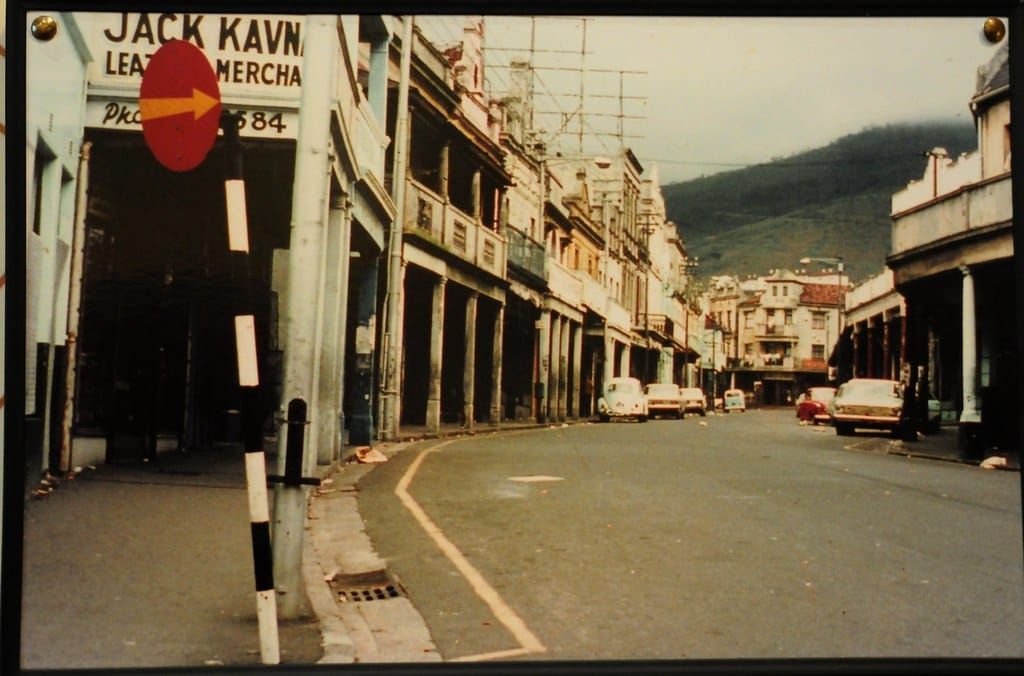
District Six itself exists more in memory than it does in the moment, despite the delayed and inadequate efforts of post-apartheid administrations to revive it just enough to be worthy of a stop on the red top bus. In that the city has succeeded: the museum tells the story of a District Six not too distant from the idealised tapestry of life captured in Rive’s most famous novel, Buckingham Palace. Step inside the renovated church on the corner of Buitenkant and Albertus street. Meet the Estelles, the Mannes and Broertjies, and pay a visit to the echoes of Mr Angelo Baptiste. Inhale the scent of boiling fish oil from Millard’s , and lick the sweat of Saturday morning markets off your lips. Recreated and repackaged to evoke nostalgic reminiscence even in a transient tourist armed with a selfie stick and an itinerary that allows fifteen minutes for grief.
But in improving the material reality of daily life in today’s District Six, the city has failed. Empty bottles of Savannah Lights are piled high on a street corner, waiting for the bin pickers’ Monday morning shift. Makeshift dwellings lie restless in the shadows of derelict buildings, waiting for the local police force to come in. Even KFC packets cling onto tree branches in the wild summer wind.
With the exception of the “East City Precinct”, with its sulphur-free Sauvignon Blanc and its artisanal bread and its oat milk and its turmeric ginger shots, District Six lies as a seeping, open wound in the heart of the city centre. Even the view of Table Mountain has lost its shine.
No, there is no sky here either. Only the weight of what was once cleared away.